The Newton's pendulum is example of collision between two bodies of the same mass - like two billiard-balls. After the collision, the two bodies fly away at a right angle.

But if the collision is perfectly central, as it should be for the pendulum, the first sphere stops and the other moves away. The two spheres exchange their quantity of motion (momentum) and energy.
The games becomes unpredictable if we take one sphere away. Collisions aren't perfectly central anymore and the motion becomes chaotic soon.
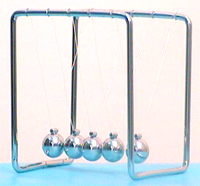
Newton's Pendulum is an exemplification of the law of conservation of energy and momentum; in this particular case collisions are nearly perfectly elastic and nearly central. The ball which collides with the other one which is static passes its momentum and kinetic energy to it.
Let us take two spheres, of which sphere no. 2 remains in quiescence.
Before the collision their momentum is mv1 and after the collision it is mV1+mV2 (lower case 'v' letters denote the velocity of the spheres before the collision and upper case 'V' stands for the velocity of the spheres after the collision).
One equation does not suffice to find the unknown velocity of the two spheres V1 i V2.
If the collision is elastic (the spheres are made of steel), their kinetic energy is conserved:
Therefore the velocity in question is V1 = 0, V2 = v1 respectively.
Now, let us play with the pendulum.
1. Two spheres
Get hold of three spheres with your hand and hold them aside. With your other hand let go one of the remaining spheres. The released sphere gets stopped whereas the one which was static bounces off. It is called 'relay race' in sport.
2. Three spheres
Let us take three spheres and release one of them. It is as if the first one collided with the other which bounced off, collided with the third one and stopped. Clear?
3. Two spheres out of three
Get hold of two spheres at one side, let them collide with the third one which is static. Two spheres bounce off, only the first one at the side stops.
Let us analyse this collision in the following way. The 'middle' sphere hits the third one and stops. The third one bounces off. In the meantime the first one approaches and sets the 'middle' sphere in motion again. The second and third one bounce off.
Everything happens so quickly, it looks as if it were only one collision.
Have a good time!