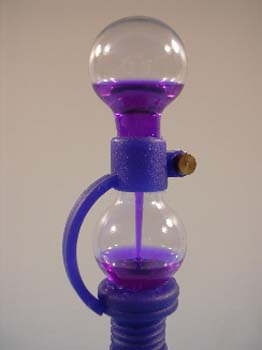
There is some coloured alcohol (or other highly volatile liquid) inside the container. If you hold the container in a warm hand, the level of liquid will rise instantaneously, much quicker than it usually does in a clinical thermometer. Apparently, this phenomenon is not a typical example of liquid expansion as we see in a thermometer.

Above the alcohol surface there is air, mixed with alcohol vapour. The alcohol is in thermal equilibrium with its saturated vapour. When the lower part of the container gets warmer, the equilibrium changes and the pressure of the vapour above the liquid rises. The pressure, which is higher than the pressure in the upper bulb, forces the liquid upwards. The warmer the hand is, the quicker the liquid rises.
When you hold the lower bulb of the thermometer, and your hand is warm enough, the colourful liquid will rise shortly after, and indicates what temperament you have. If you keep in hands both upper and lower container, the pressure rises in both of them and hardly the liquid moves up or down.
It is easy to assess the changes in pressure between the upper and lower container of a Love thermometer. Let us assume that pg denotes the pressure in the upper container and pd the pressure in the lower container. After the liquid in the tube inside rises, the pressure volume on the lower surface of the liquid must be equal to the pressure in the upper container and the pressure of the column of liquid in the tube.
pd = pg + ρgh
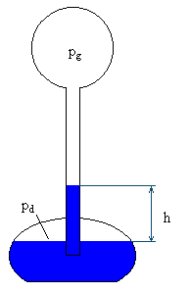
With alcohol density of ca. 800 kg/m3, pthe difference in pressure of 80 Pa rises the liquid by 1 cm.
The rate at which evaporation process takes place depends on the difference between the pressure of saturated vapour pn at T T temperature and the actual pressure of vapour p, or more precisely:
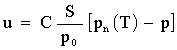
S denotes the surface of liquid, C is the coefficient characterising the specific liquid and p0 stands for external pressure, i.e. it is the sum of component pressure of individual gases which are not vapour. The relation between saturated vapour and the temperature is non-linear. It rises relatively quickly with the rise in temperature. For volatile liquids, whose boiling point is only slightly above the room temperature, even slight changes in temperature bring about considerable changes in pressure.