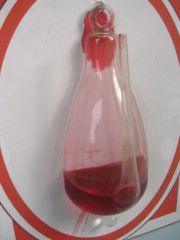
How do we forecast the weather? Some forecast the weather when their bones are aching. But a barometer is more reliable. You can see one in the picture. It resembles a closed wine pitcher and is called Goethe barometer. If the atmospheric pressure is high, the level of liquid in the spout is low. When the pressure is low the liquid moves up.


Goethe barometer consists of two connected vessels filled with water (coloured would be best) in such a manner that there is no air flow between those two containers. The bigger container is tightly closed at the top, so that the air inside cannot escape. If the atmospheric pressure rises, the water in the spout will be forced inside, as the pressures inside have to be balanced, and the level of water in the spout will drop. In the other container, the change is imperceptible as the diameter of the container is much bigger. In contrast, when the atmospheric pressure is low, the level of liquid rises.
Unfortunately, this barometer is not particularly precise and the air presence in the bigger container is the main culprit.
Goethe's Barometer is a very simple instrument and its readings are inaccurate.
Let us assume that pa denotes the atmospheric pressure at the moment of filling the barometer with liquid and Va denotes the volume of air in the bigger container at the same pressure. If the atmospheric pressure changes to the volume of px, the volume Vx (provided the temperature is constant) is:
Vx = paVa/px
The difference in the volume ΔV is the amount of liquid by which the volume in the bigger container increases/ decreases and it is:
ΔV = Vx - Va = (pa/px - 1)Va
which difference is balanced by the decrease/increase in the volume of the liquid in the other container. For example, we assume that the surface area in the bigger container is 50 times bigger than the surface area in the other one. If the level of liquid in the narrower container changes by for example 5 mm, it will change by 5/50 = 0.1 mm in the bigger one. Such a change is almost imperceptible. But we did not take into consideration the changes in temperature.
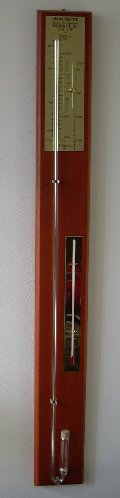
By contrast with Torriccelli barometer (see the picture), there is gas, not vacuum, in the closed part of Goethe's Barometer. The rise of temperature causes the gas expansion in the closed part. This in turn (at a constant external pressure) changes the readings.
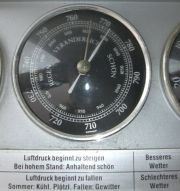
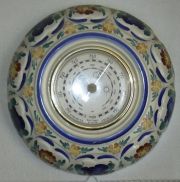
The barometer's inaccuracy can be attributed mostly to the fact that there is water inside it, not oil with low compressibility of vapour. The pressure of water vapour increases with temperature non-linearly, considerably faster than the pressure of gas (dry, so called perfect), see the psychrometer.