Psychometer is not used to check the mental state of patients, but to measure the humidity of the air. It is a simple device made from two thermometers, some gauze, and a water container.


The principle of operation is very simple. One of the thermometers measures the temperature of the environment. The other is covered with gauze which is saturated with water from the container. The water vapours from the gauze taking the heat from the container. As a result, the temperature on the thermometer falls. This process is counterbalanced by the heat provided from the environment. This results in the thermometer showing a certain temperature after the amount of heat consumed in vaporization has been balanced with the amount of heat received from the environment. The rate of vaporization depends on the amount of water vapour present in the air. That is why the temperature drop depends on relative humidity.
Thus, in dry air, when you put a wet towel on your head, it will help you cool your hot head. While in a sauna even a wet towel will not help.
The psychrometer measures so called relative humidity - not the volume of water vapour in the air in absolute units, but the potential capacity of air to 'accommodate' water vapour at a given temperature. Relative humidit "w" (percentage share) can be calculated with the application of the following formula:
w = 100e/E
in which e is the compressibility of vapour at a given temperature and pressure E is the compressibility of saturated vapour under the same conditions.
Sprung's equation can be applied to calculate "e" value.
E = E1 - C·(p/1013)·(T-T1)
E1 is compressibility of saturated vapour at the temperature shown by the moistened (T1) thermometer, p stands for pressure (in hPa), and C is psychometric coefficient equal 0.5 for water and 0.43 for ice.
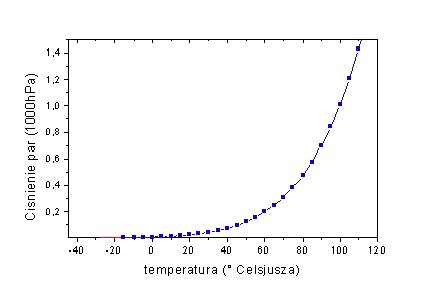
Since the relation for E1 p is quite complicated and it is non-linear, as can be seen on the graph, the assessment of the volume of humidity is arrived upon reading the temperature on both thermometers and interpreting this information with the special tables. Thus, at the temperatures of 20 oC and 10 oC as shown by a regular and moistened thermometer respectively the relative humidity is 24 %, 24%, at 30oC and 20oC the relative humidity is 39%. Generally, the smaller the difference between the temperatures shown by two thermometer, the higher the humidity. And vice versa, the bigger the difference, the drier the air. The above relations are non-linear, because of non-linear relationship between compressibility of saturated vapour and temperature.