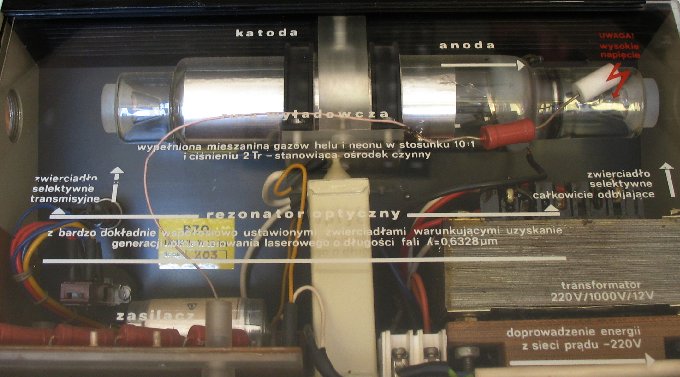
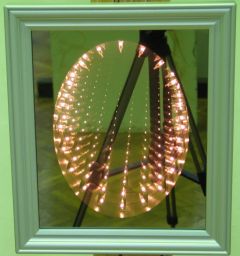
When you look into that 'window' you see a long tunnel with lamps. In reality it is a shallow box with two mirrors; one of them is at the bottom and reflects everything and the other mirror placed at the front and is half-transparent. Behind the front window, a line of lamps shines.
The image of those lamps is reflected in the bottom mirror and the image of this image is reflected in the front window creating an impression of an endless line of lamps.


A laser tube operates on the same principle. It ends with two mirrors; one of them reflects all the light/beams and the other only some of them.
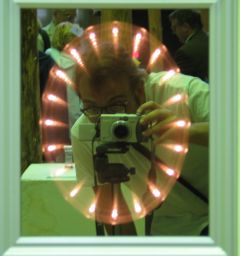
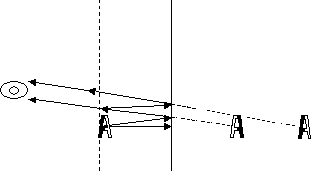
The image of a line of lamps is reflected on the bottom of the box - and seems to be within the distance of 10 cm from the first line of lamps. The reflected beams fall on the front glass and are partly reflected again by the mirror at the front. Having fallen on the mirror from inside they create another image of a line of lamps, seemingly within 20 cm from the 'real' lamps. More and more lines of lamps seem to be concentrically arranged one inside the other. The intensity of the light reflected decreases in each successive reflection. The light of the lamps seems to get dimmed in each successive reflection, like the lights at the end of a tunnel.
A laser tube operates on a similar principle: a light emitting source (a gas or a crystal) is positioned between two 'half-transparent' mirrors (in fact they reflect 99% of light and more). The light is reflected and penetrates many times inside the emitting material, interacting with atoms or molecules (like in the CO2) and gets amplified (it sums up with the radiation due to a forced emission). The working principle in the laser is the same as in our "light tunnel": lengthening of the optical path.