Two hard balls hang on separate strings. They can collide in continuation if you move rhythmically your hand. Each of the balls will move along its own semicircle and collide with the other one in the highest and lowest position. If we do not supply constantly the motion to the balls, they will stop collisions immediately. There are no ideal elastic collisions and in each collision the balls loose some energy, at least for making noise.
The balls have the same mass and they collide centrally with the same velocity, but the directions of the velocities are opposite. As a result, they bounce off each other in opposite directions, again with the same velocities. If one of them stops, then, after next collision, they bounce off each other at a right angle (or one of them stops, like in the Newton's Pendulum).
But generally speaking , this problem is rather complicated.
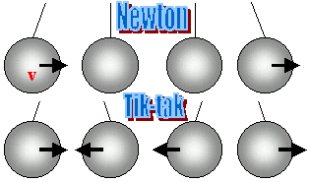
Rhythmical movement of your hand supplies two hard balls with the amount of energy equal to the energy lost in the collision, therefore the balls neither accelerate nor slow down.
On the other hand, after watching closely the way in which the balls are made to collide you can come to the conclusion that the direction of the hand movement and the directions of the centres of gravitation movement of the balls must be aligned correctly. That means that collisions must be central, if you want the balls collide regularly.
Riki - Tiki is a kind of Newton's Pendulum with two hard balls at the lower end. Another difference is that both balls can swing. Let us denote the initial velocity of the balls with v and -v their velocity after the collision with V1 i V2.
The conservation of momentum equation has the following form:
mv - mv = mV1 + mV2 this in turn leads to the following conclusion: V1 = - V2
and the energy conservations says:
½mv2 + ½mv2 = ½mV12 + ½mV22
Having taken the first equation into consideration, the following result is obtained |V1| = |V2| = |v|. In the above result, only absolute velocities are obtained. There is no indication which of the V1 or V2 is positive and which is negative. As a matter of fact, we do not know which of the two balls bounced off to the right and which bounced off to the left (and even whether or not the collision came about...).