If we leave two balls fall together and from the same height, they will rebound almost up to the same height. Anyway, something strange happens if we put the lighter little ball (a ping pong one) over the heaviest (of caoutchouc). The ball that was over squirts to the ceiling.


In the instant of fall on the ground a hidden collision occurs: the bigger ball rebounds on the ground and changes the direction of the velocity vector before the smaller one, which continues to go toward the ground. Due to the elastic collision the quantity of motion of the heavier ball is transmitted to the lighter ball and therefore this latter one rebounds to a major height.
Once again we convince ourselves that we must not believe in illusions. The behaviour of the balls don't contradict principles of conservation in physics.
The lighter ball will never soar up higher if it bounces off a (static) floor.
In fact we are dealing with a (hidden) collision between two balls. The red one collides with the floor earlier, changing its vector of velocity, the vector of velocity of the orange ball remains directed downwards. As a result of an elastic collision, the momentum of the heavier ball is transferred to the lighter ball which bounces off much higher..
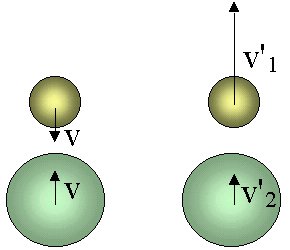
Let us explain it more precisely. Assuming that the mass of the lighter ball is m and the mass of heavier one is M and assuming that they were dropped from the height of h, we conclude on the basis of the energy conservation law that at the moment of collision the velocity of a smaller ball is -v whereas the velocity of a bigger ball is v (i.e its vector has opposite direction). If we apply again the law of conservation of energy (we take it for granted that the collision was elastic):

and the law of conservation of momentum

the velocities after the collision are:

for the lighter ball and

for the heavier ball, respectively.
Assuming that m is considerably smaller than M the above v value can be estimated as:

in other words, considering that kinetic energy is converted into potential energy, the smaller ball bounces off nine times higher than the heavier one.
The v1' = 3v and v2' equations seem to contradict the conservation laws: the heavier ball has maintained its velocity, and the lighter one has trebled it 'out of nothing'. This seeming paradox is caused by the approximation M >> m; it would happen if a basketball collided with a tennis ball. Since the mass of both balls does not differ considerably, what we see is just what the experiment shows: the light ball bounces off higher, several times higher than the height from which it was dropped, the heavier ball bounces off slightly lower.