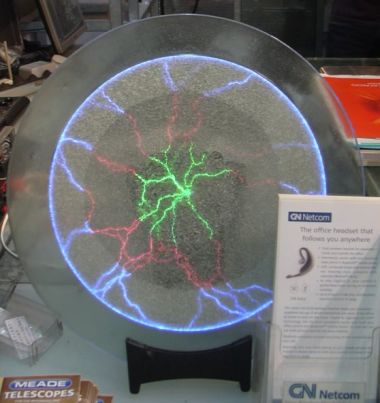
What is the perfect gift for St. Valentine's Day ? It definitely is the 'I love you ' lamp with a green leaf and a red heart.


After switching the electricity on the bulb lights - the hearts glow in red and the letters in green. Actually, it is not the hearts that glow but the reddish mist around them.
The bulb is filled with noble gas, neon under low pressure. The electrical discharge in neon creates red afterglow. The plate with the words is covered with a fluorescent paint which glows in green under bombardment of discharged electrons.
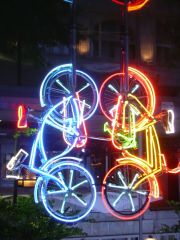
Nowadays it is very difficult to find a neon-filled bulb which would glow in red. The so-called 'neon' bulbs contain argon and mercury and glow in white (or argon and sodium, and glow in yellow). Similarly, a 'real' fluorescent screen glowing in green and covered with zinc sulphide can be found only in old oscilloscopes or black and white TV sets.
The luminescence phenomena are quite common. Some old clock faces illuminate in the darkness without any battery. We call this effect - phosphorescence. It had been observed long before it was explained.

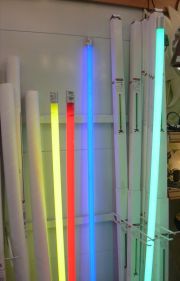
The reason for photoluminescence is that atoms or molecules, absorbing energy, get excited. An electron in such an atom passes to a higher energetic state. An excited atom can re-radiate energy, when the excited electron comes back to its fundamental state.
Illuminating by UV light brings atoms to relatively high energetic states. Usually, atoms come back quickly to the fundamental states. But it can also happen, for some atoms that electrons do not come back to the same fundamental state but "jump-down" to some lower intermediate state and only later, from this intermediate state they come back to the fundamental state. So two photons are emitted, both of them carrying lower energy than the impinging photon, and one of them can be in the visible range. This is "fluorescence" effect, as in the case of our "Love" lamp.