The so-called voltaic cell can be made up by a lemon, by a potato, or even by hands with two metals . Millions of these cells are used every day in telephones, computers, walk-man and clocks.
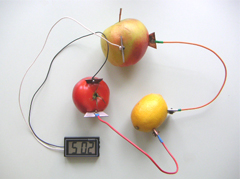
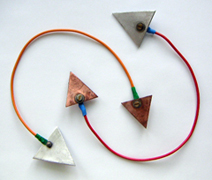
The lemon battery is an example of voltaic cell: electro-chemical reactions generate electric current. The little plates (of copper and zinc) are the electrodes. Electrolyte is a watery solution of different acids which can be found in every fruit or vegetable.
The first Volta's pile was just a heap of coins. He quickly developed a cheaper battery - a series of glasses with sulphuric acid, connected by zinc and copper strips, see the photo. Each "half" glass, with one of the two electrodes and half of the acid can be considered as an elementary pile.
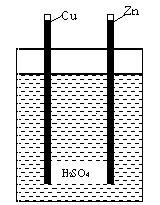
On the electrodes, reactions of oxidation or reduction occur. On the anode, i.e. the negative electrode (in the case of Volta's pile it is Zn electrode) the reaction of oxidation takes place; on the cathode, i.e. the positive electrode (Cu electrode) the reaction of reduction takes place. Electrons travel across the metal wires from one half-pile to the other one.
In the case of a lemon pile, the electrolyte is the solution of many acids which are present in any vegetable or fruit. The reaction on the Zn anode is the following:
Zn(s) → Zn2+ + 2e
Zinc ions get dissolved in the electrolyte, and electrons pass to the Cu plate. On the Cu electrode the copper Cu2+ (or H+) ions are reduced by incoming electrons from the connected Zn plate; metallic Cu is deposited on the cathode.
Cu2+ + 2e → Cu(s)
In this way, Cu ions (if present) are removed from the solution are removed and substituted by Zn ions. The electric energy is generated from chemical reactions. As said before, not only Cu2+ ions but also H+ can be deposited on the anode, and they can form the hydrogen H2 gas.
Electrochemistry is an old science (it is over 200 years since Volta invented his first pile) but the phenomenon discussed above is still not fully understood.