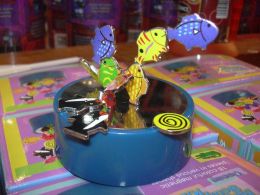
The spinning-top wraps a snake up itself by spinning. If another snake gets closer, the spinning-top starts dancing around them.

The metal extremity of the spinning-top is magnetic, this making the metal snakes attracted to it. The spinning-top moves onto the circumference of the snakes by spinning.
Moreover the multi-colour striped spinning-top, dancing around the snakes, hypnotizes the observer by its measured movements.
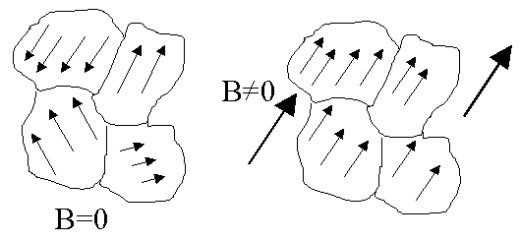
The blades of the snake are made of steel, which is co-called ferromagnetic. Ferromagnetics are substances with strong magnetic properties - each atom of this material creates its own magnetic field. Moreover, these atoms tend to orient themselves in the same direction, in a way that the fields created by them are parallel. In this way macroscopic regions called "domains" are created, with a constant direction of the magnetic field inside. Then, the magnetic fields of single domains are oriented in different directions, forming a kind of mosaic. For this reason, the ferromagnetic itself may not create an external magnetic field, i.e. may not behave as a permanent magnet. But when a ferromagnetic is placed in the external magnetic field (for example from a permanent magnet) it gets magnetised externally, as well.
The domains which have already been oriented in one direction hardly ever come back to the initial chaos of magnetic directions. Even if the external field comes to zero, they still show an external magnetic field - the ferromagnetic became a magnet.
Substances which de-magnetise easily (i.e. small external fields are sufficient to make the domains oriented in one direction) are called soft ferromagnetics. The blades of the snake are made of such a material, in contrast with the tip of the top, which is made of a material getting demagnetised with difficulty, i.e. a hard ferromagnetic.
It remains to be explained why the magnetic tip attracts the edge of the blade, and not its centre. This is somewhat similar to the forces of electrostatic induction which attract small pieces of paper always by their sharp edges (where the induced field is the highest).
In the same way the magnetic needle of a compass is magnetised "longitudinally" and not perpendicularly. Magnetic domains are inclined to orient themselves "one after another". In this way the energy of the system is minimised.