
Magnetic star
The iron ball inserted between poles of different signs get magnetised in a "normal" way, becoming a two-pole magnet (N-S), with the axis oriented in the direction of external magnets.

The ball between two poles of the same sign "accommodates" its magnetic poles in a way to be attracted by both external magnets. It means that near the external poles, opposite sign poles are created inside the ball. For example, if the external poles are "N", than close to them, inside the ball, "S" poles are created, as in the picture here. But, as magnets show always two poles, the complementary poles must appear somewhere. It turns out (one can use the magnetic screen described before) that these complementary poles (or a single, distributed "N" pole) is formed in the perpendicular plane to the "S"-"S" axis.
In the first case of opposite sign poles, both of the induced poles were positioned on the axis, in the second case of the same sign poles the induced pole sticks-out of the axis, and is seen by the magnetic screen.
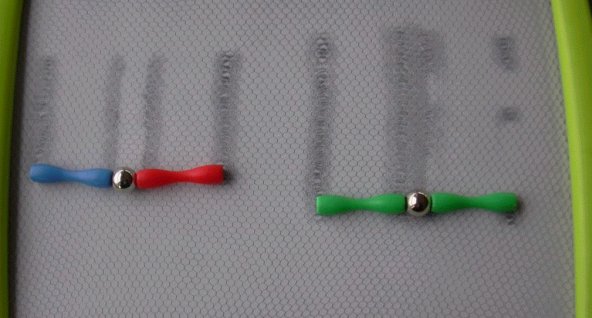
The ball magnetised in such a way becomes a multi-pole magnet.

A four-pole electric field is used, for example for trapping ionized atoms, in a quadrupole mass spectrometer.