The colourful glass bulbs inside the glass cylinder indicate temperature of the room. When the temperature of the liquid changes, its density changes as well. The bulbs, floating in the liquid, fall down when the temperature rises. Which of them float and which fall, depends in liquid’s density.
The glass bulbs are filled with colourful liquid and equilibrated to float by small weights. The mass of the bulbs is matched, at a given temperature, with Archimedes’ force coming from the liquid in the cylinder. If the temperature in the room rises, the liquid in the cylinder (e.g. alcohol) expands and its density becomes smaller. The Archimedes force acting on the bulbs decreases because their volume does not change as dramatically as the volume of the liquid in the cylinder does and as a result some of the bulbs fall down.

The problem may arise when the temperature is either too high or too low, as, subsequently all of the bulbs will either fall to the bottom or float at the surface.
Density of liquids and solids usually changes with temperature in a linear way. More precisely, the density decreases with the temperature, as described by the following equation:

where B jis a coefficient of thermal expansion and T0 the initial temperature. For water B is ca. 0,21·10-3 K-1, and for glass it is - 0,01·10-3 K-1 - 0,03·10-3 K-1, where as for isopropyl alcohol it is 1,1·10-3 K-1 (Isopropyl alcohol is often used in Galileo thermometers.) The lower the coefficient of thermal expansion, the smaller the change in density. The above comparison of coefficients allows to draw a conclusion that density of liquids changes considerably with the temperature, whereas glass bulbs density changes very slightly. With the rise of the temperature the liquid becomes lighter (in the same unit of volume) but glass bubbles do not and that is why they sink.
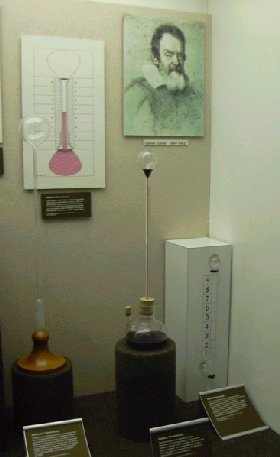
As a matter of fact the first Galileo thermometer, a container with some liquid and a thin tube resembled a present-day medical thermometer with mercury inside.
Remember that glass expands little with temperature, but it also conducts poorly the heat. So when using glass and trying to heat it, please choose glass with a very low expansion coefficient, like so-called pyrex (with the expansion coefficient really small, 0.003·10-3 K-1).