There are colourful blobs in a lamp filled with liquid which travel upwards to the top and than fall down. The illuminating bulb sits in the base of the glass and as a result the blobs shimmer colourfully.
The phenomenon causing the movement of the blobs is known as convection; that is the transfer of heat by currents within liquids or gases. In this case, the liquid is heated at the bottom of the lamp which results in the decrease of the density of the liquid, hence the liquid arises.

The phenomenon of convection has a wide range of applications in various fields of science and technology, such as Physics of the sea and atmosphere. At the equator, it takes just a few hours on a sweltering day for a storm with lightning to appear as a result of the transfer of the humid air caused by convection. Beautiful cumulus clouds form even at higher latitudes on a spring day, resembling big dollops of whipped cream. They rise with convection currents till they reach the altitude of a few kilometres where the air is cooler and there they break and eventually fall as the rain.
The base of lava lamps heats oil blobs submerged in a different liquid at the bottom of the lamp. Heating changes the density of the blobs and they rise towards the top of the lamp due to increasing Archimedes force. At the top of the lamp, which is slightly cooler, the blobs dissipate the heat, they become denser and begin to fall down.
The density of the oil blobs and the density of the liquid are chosen so that they are 'almost' equal. Since they do not mix, several competitive processes take place:
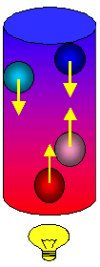
1) The liquid and the oil have slightly different coefficients of thermal expansion. The liquid has a smaller one, its density changes less than the density of the blobs. Thus, the blobs with rising temperature change their density much more than the liquid, so they get relatively lighter and drift upwards.
2) Specific heat capacity for two liquids which do not mix may differ, one liquid can be heated faster than the other. Water, whose specific heat capacity is 4200 J/kg·K, will heat at a slower pace compared to turpentine, whose specific heat capacity is 1800 J/kg·K.