How to warm some coffee during a snow storm in the mountains? It's simple! Push in the bottom of the container and shake for 40 seconds. The coffee is ready! The commodity is 2 Euros, but who wouldn't spend it to get warm during a snow storm? And there is a different treat for summer: frozen coffee. For the service manual read above!


In fact, the container has a double bottom. A cooling or heating mixture is placed in the bottom part of the container. The coffee is in the top part. To heat something we use a reaction of calcium chloride with water, and to cool something we dissolve sodium thiosulfate (photographic fixer) in water.
But why do certain materials heat when they dissolve or melt, e.g. acids, and others cool? It has yet to be determined. Experienced chemists say it just happens that way.
During the process of dissolving, water molecules, possessing a high dipole moment, interact with cations and anions (positive or negative ions, see Volta's tongue) of the dissolving material. The oxygen part of a water molecule attaches to positive ions and the hydrogen part sticks to negative ions and detach them form the solid. Mixing brings new water molecules to the solid and accelerates the salvation process (is more rapid). Let us consider the dissolving process in two steps.
First, as a result of dissolving cations and anion, free spaces are filled by free atoms or molecules. The value of the energy associated with such a process (in chemistry it is better to say "enthalpy" instead of energy) is equal to the enthalpy associated with the formation of the solid from gas. For calcium chloride the calculation gives
CaCl2(sieć) → Ca2+(gaz) + 2Cl-(gaz), ΔHsieć = 2260 kJ .
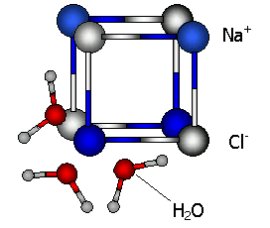
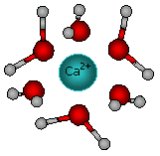
Next, ions get inside the liquid - water molecules concentrate around ions. As the interaction between ions and water (or other liquid) molecules is attractive, the enthalpy of this process is always negative (the energy is gained
Ca2+(gaz) + 2Cl-(gaz) → Ca2+(hyd) + 2Cl-(hyd)
For this process ΔHhyd = - 2337 kJ.
The total change of enthalpy is the sum of these two processes. In the case of calcium chloride, this sum equals ΔH = -77 kJ. The negative sign means that heat is formed during dissolving - the coffee mug becomes warm. Other substances require the energy from outside to be dissolved - the coffee gets cold.