Everyone must have blown soap bubbles at some point in his life. They can be blown by use of a straw, a ring, or even a toy machine-gun. To get big bubbles, we should use a mixture of six units of water, 2 units of dishwashing liquid, and one unit of glycerine (it is available at the chemist'). The mixture should be left for some 6 hours. You can use a metal ring with the diameter even as big as one meter to blow gigantic bubbles, provided you have a big enough bathtub.


The bubbles blown from complicated frames e.g. a cube, assume unique shapes, minimizing the surface.
The question remains, why soap is added to make the bubbles long even though we know that soap decreases the surface tension of a liquid. It seems that by decreasing the surface tension, we weaken the forces that keep the bubble together in one piece. In fact, it is only after the surface tension has been lowered, can we stretch water in long layers. Without soap the cohesion forces are too strong. A water drop is indeed very dense!
How come (after adding detergent to water which considerably lowers its surface tension) the dishes covered with a film of fat (which is insoluble in water) were washed with small amount of washing up liquid?
The detergent molecules consist of two different chemical parts joined by strong bond. One of the parts is usually hydrophilic (it attracts water) and the other is hydrophobic (most often it is carbohydrogen chain) for example sodium stearate CH3(CH2)16COONa (see the picture).
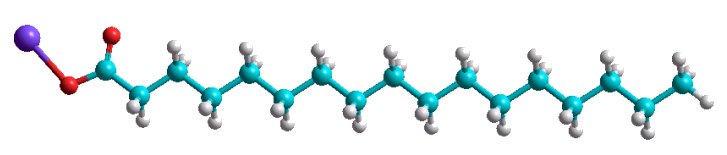
Such molecules are called amphiphilic (from Greek - "loving both"). After adding amphiphiles to, for example water with oil, hydrophilic molecules will organise molecules of water around themselves, whereas hydrophobic molecules will organise the molecules of oil, so as to prevent energetically disadvantageous contacts of water with oil from occurring.
In a similar manner, although glycerine mixes well with water (both compounds are strongly polar) adding detergents to such a mixture causes mutual reorientation of the molecules of water and glycerine, leading to more energetically favourable arrangement, and lowering the surface tension. Big soap bubbles can be produced.